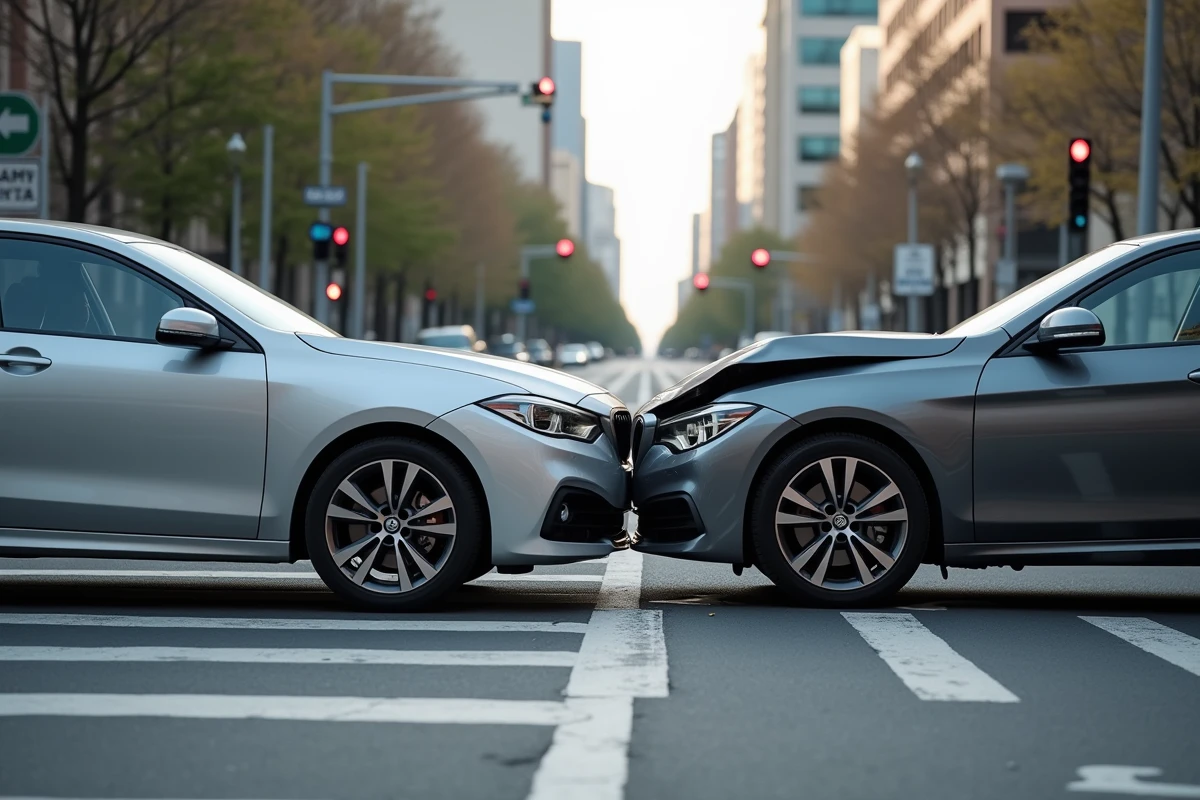
A side collision between two cars almost always leads to a disagreement over liability. Unlike a rear-end collision, where the presumption of fault is relatively clear, the impact on the side of a vehicle requires a precise reconstruction of each driver’s trajectory. French law does not provide a single rule to resolve this: it all depends on the circumstances, adherence to the highway code, and how the amicable report was filled out.
Amicable report and side collision: what insurers look at first
In a side collision, the “circumstances” box on the amicable report becomes more crucial than in any other type of accident. Insurers do not simply tick boxes: they cross-reference the written description, the sketch, and the points of impact indicated on each vehicle.
The sketch, often hastily drawn under stress, is nevertheless the key piece of evidence. A misplaced line or an absent directional arrow can shift the assessment of fault. For a side collision, the insurer seeks to determine who was in their lane, who was changing lanes, and who had the right of way at the moment of impact.
The IRSA convention, applied between insurers to settle claims without necessarily going through a court, relies on these elements to assign a percentage of liability. Understanding liability in the case of a side collision therefore requires knowing how to correctly fill out this document, particularly the descriptive part.
- The sketch must indicate the exact position of the vehicles before, during, and at the moment of the collision, with clear directional arrows.
- The impact area on each vehicle (front wing, door, rear wing) provides information about the collision angle and the dynamics of the accident.
- The “circumstances” boxes checked by each driver are compared: any inconsistency between the two versions triggers a contradictory expertise.
- A precise handwritten description (street name, direction of traffic, existing signage) carries significant weight when the accounts diverge.

Priority to the right, lane change, maneuver: three very different side collision situations
The French highway code establishes a simple principle: the vehicle coming from the right has priority at unregulated intersections. In a side collision at such an intersection, the driver who failed to yield to the vehicle approaching from their right will be deemed responsible, unless there are special circumstances (traffic light, stop sign, yield sign).
The situation becomes more complicated on multi-lane roads. A driver who changes lanes and collides laterally with a vehicle normally traveling in the adjacent lane is generally fully responsible for the accident. The one maneuvering must ensure that they can do so safely, in accordance with article R. 415-4 of the highway code.
Exiting a parking space and merging from a parking lot
This case is among the most common and least understood. A vehicle leaving a parking space at an angle or exiting a parking lot is performing a maneuver. The presumption of fault weighs on them, even if the collision occurs on the side of the vehicle in motion.
The vehicle maneuvering is presumed responsible, including during a U-turn or reverse maneuver that caused a side impact. The available data does not always allow for a clear distinction between who was driving and who was maneuvering, which explains why these incidents often result in a shared liability.
Shared liability in a side accident: how the 50/50 split applies
When the circumstances do not allow for the exclusive fault of one driver to be established, insurers apply a shared liability. The most common case: two vehicles change lanes simultaneously and collide laterally. Neither can prove they occupied the lane first.
This 50/50 split has direct consequences on compensation. Each driver bears half of their own material damages if they only have third-party insurance. With comprehensive insurance, the insurer covers all repairs but applies a penalty to the driver’s bonus-malus coefficient.
The impact on the bonus-malus coefficient
An accident with shared liability results in a reduced increase in the coefficient, unlike an accident with total fault. This distinction matters in the long term: a 50/50 split increases the coefficient to a lesser extent than exclusive fault, but it still affects the insurance premium at the next renewal.
On the other hand, a driver found to be completely not at fault for a side collision does not suffer any modification of their coefficient and benefits from full coverage of their damages by the insurer of the responsible party.

Challenging the insurer’s decision after a side collision
The allocation of liability decided by insurers through the IRSA convention does not have the value of a judgment. A driver who believes they have been wrongly assigned fault has several avenues for recourse.
- Submit a written complaint to their insurer, attaching any new evidence (witness statements, photos, dashcam video, police report).
- Contact the insurance mediator if the disagreement persists after the insurer’s response.
- Initiate legal proceedings before the competent court, the only way to obtain a binding decision that applies to both parties.
Supplementary evidence regularly changes the outcome of a case. An onboard video showing the actual trajectory of the vehicles or an independent witness can reverse an initial attribution of liability.
The time limit for contesting varies by insurer, but the statute of limitations for automobile insurance is two years from the event. Waiting several months without reacting significantly reduces the chances of having the decision changed, not least because witnesses become harder to locate and memories fade.