With the rise of companies that manufacture mass-produced furniture, the profession of cabinetmaker is fading. At the same time, they remain the fastest person to restore your old furniture and traditions. Focus on this artisan profession that aims to master woodworking. Becoming a cabinetmaker is not for everyone, even though the required qualifications are not of the highest educational level. It is a manual profession that demands artistic qualities.
Summary
- What are the cabinetmaker’s tasks?
- Becoming a cabinetmaker: studies and future prospects
- What studies?
- Careers
- salaries
and opportunities
The cabinetmaker’s tasks: what is it about?
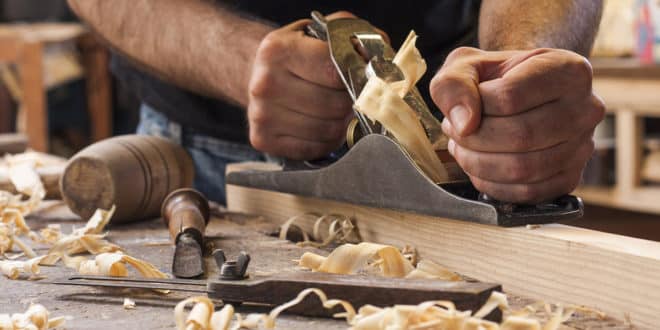
The cabinetmaker has only one mission: to work with wood. It is his passion, his field. Now, he can perform several actions on this material. The main part of the business is to create custom wooden furniture where they are involved at every stage of the process. Let’s take an example. You are a client and you want a new wooden piece of furniture with very specific dimensions; you go to the workshop of a craftsman cabinetmaker. His role is to welcome you and gather your wishes as well as your requirements, such as the fact that your furniture must be able to support certain loads or have a certain number of compartments. This is about pre-defining the model to be created. Once you have agreed, he will need to proceed with the drawing and design of the latter according to your constraints. Now, he will have to work the wood. In short, he must cut the pieces to the correct measurements and apply curling veneer if necessary. Sawing, sanding, and planing are part of his daily life. Once all the necessary pieces are created, his task is to assemble the furniture, that is, to put them together and glue them. Finally, the product cannot be delivered in this way and must go through the finishing process. We mean varnishing, painting… before declaring a finished product ready for delivery. This is the routine of a cabinetmaker, but he may well have other functions. Especially in the repair and restoration of traditional furniture that will test his craftsmanship. The name of the profession comes from ebony, which is a very hard wood, but the craftsman may have to work with newer materials like glass. Furthermore, though quite rare, other professionals such as interior designers or designers may call upon such a craftsman on behalf of their own clients.
Becoming a cabinetmaker: studies and future prospects
The profession requires many qualities and skills. That is why the profession of cabinetmaker is not accessible to everyone and is somewhat fading. First of all, imagination and creativity are very important because you somehow have to create custom furniture. Setting up the plans necessarily requires knowledge of geometry. Physics is sometimes put to the test to saw and move large pieces. It is essential to have a thorough knowledge of wood and its history in order to work it as best as possible, especially during the repair and restoration of furniture. Of course, dexterity plays an important role in this craft. He must also be patient, rigorous, and perfectionist. Besides that, welcoming clients will test your human and relational side. It is essential to respond to their requests.
What studies?
You can become a cabinetmaker with a CAP but also follow a longer path up to Bac +3 with the obtaining of a DN MADE (National Diploma of Arts and Crafts and Design). So, what training should you choose to practice the profession? The CAP offers the smallest qualification, level V. You can pursue the CAP in Wood Arts with a marquetry option, that of Industrial Furniture Designer, or the one simply called Cabinetmaker. So that’s for the CAP. Then there is a level IV qualification, equivalent to a baccalaureate diploma. The BMA (Art Trades Certificate) or the BTM (Technical Certificate of Trades) with the mention Cabinetmaker will open the doors to the profession. We then move on to a Bac +2, equivalent to a BTS and thus level III with the BTMS (Higher Technical Certificate of Trades) Cabinetmaker but also the DMA (Diploma of Arts and Crafts) Living and these two options decor and furniture as well as furniture restoration. Here are the Bac +2 that will allow you to practice the profession. However, as has already been said, the most qualified artisans have a Bac +3 and more specifically a DN MADE with the mentioned object. They are theoretically the most experienced professionals in terms of the concept of wood history but also of know-how.
The salary
A beginner cabinetmaker is paid at the minimum wage. The possibility of self-employment can potentially increase the salary of independent work, but it comes with risks. It requires an investment and you will start from scratch in terms of clients and suppliers.
Careers and opportunities
Unfortunately, the trade does not offer many opportunities. An employee may open his own workshop. A specialization in layout or furniture manufacturing can open up prospects.
Finding a school
Whatever the level, you will find training programs all over France. Only the DN MADE requires access to the file and may be more difficult to obtain.
Tag: the profession of cabinetmaking