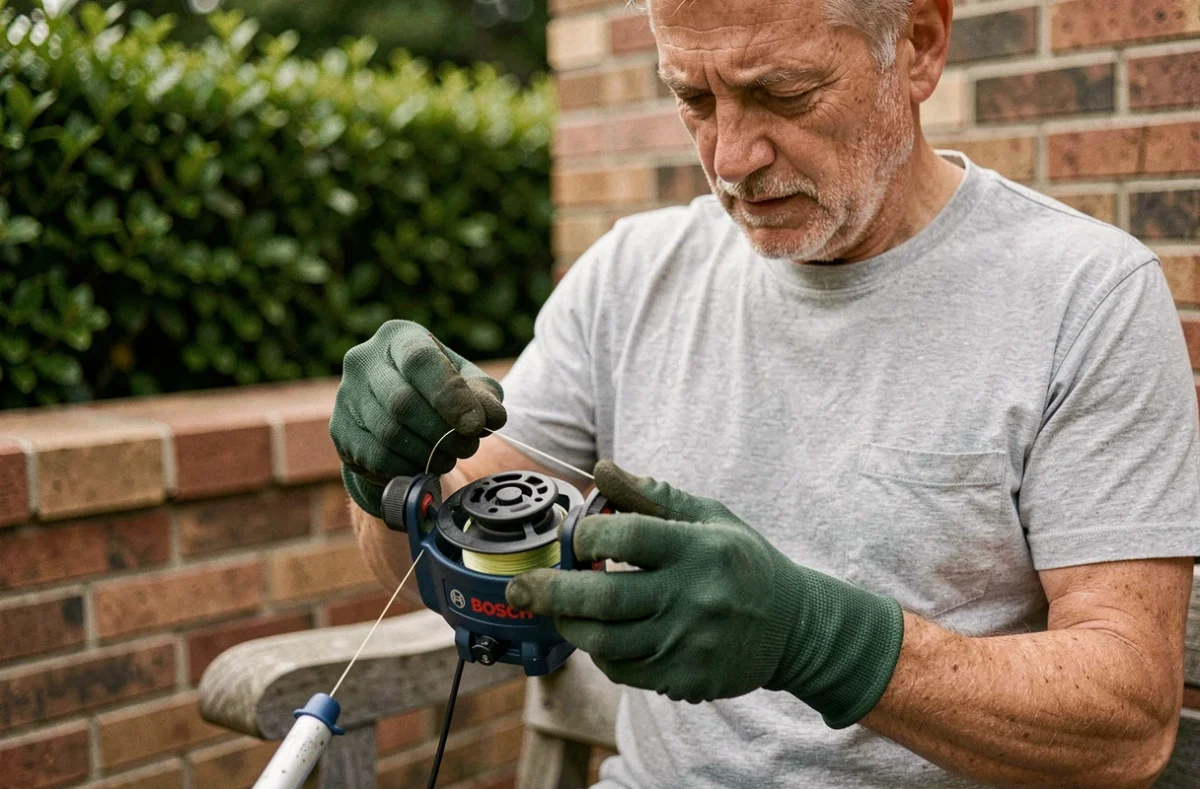
The line of a Bosch trimmer is not replaced in the same way depending on whether the head operates with automatic feed or manual reloading. Confusing the two systems causes jams within the first few minutes of cutting. Here we detail the reliable method, technical pitfalls, and key checks not to overlook during replacement.
Winding direction and regularity of coils on Bosch spool
The number one cause of jamming after a line change is approximate winding. On each Bosch spool, a molded arrow indicates the mandatory winding direction. Ignoring this arrow reverses the line tension at startup and causes an almost immediate jam of the head.
The line must be laid in regular layers, without crossing between the coils. Each turn should be placed against the previous one, like on a fishing reel. Overlapping, even partially, creates an internal friction point that prevents the line from unwinding freely.
Once the winding is complete, both ends of the line pass through the eyelets provided on the spool before closing the cover. This passage maintains tension during reassembly and prevents the line from unwinding in the casing.
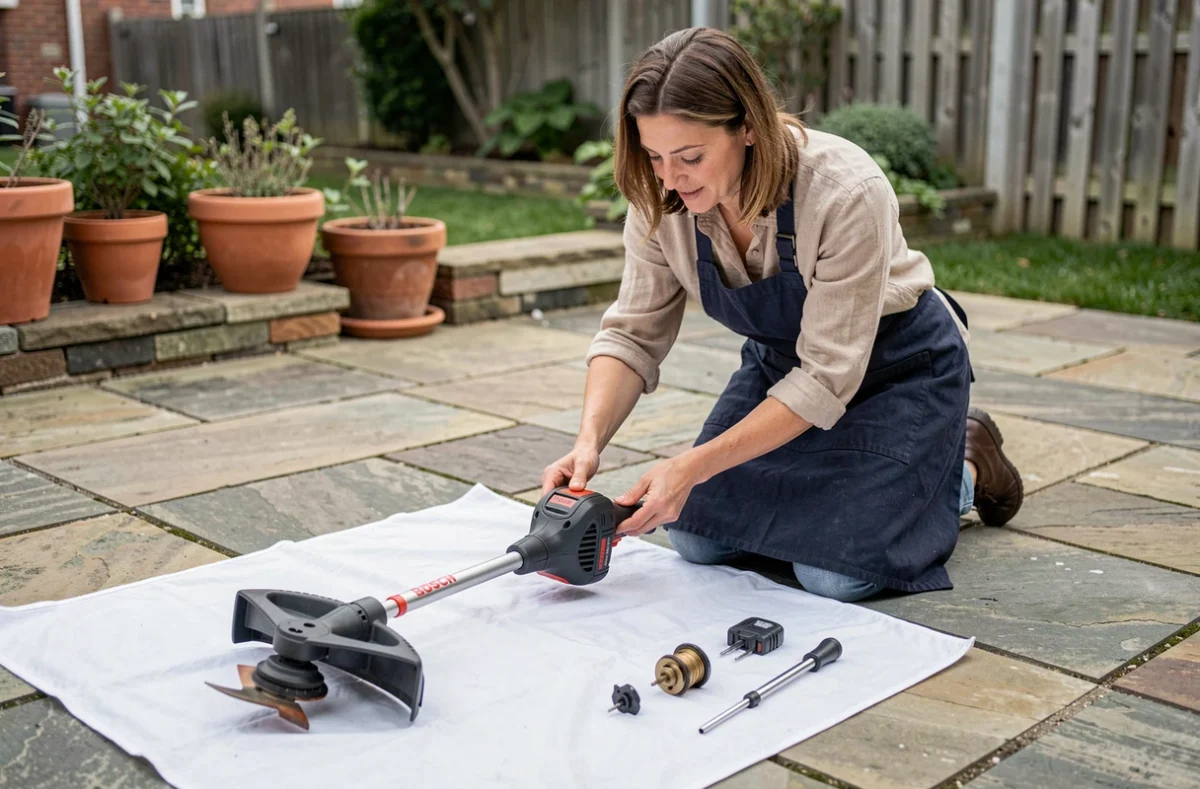
We recommend leaving each strand protruding by a moderate length, as the procedure for changing the line on Bosch trimmers provides that the blade integrated into the casing automatically brings the line back to its operating length at startup.
Line too long and motor overload: a common mistake
Leaving an excessively long line in the hope of widening the cutting width is counterproductive. An overly long line increases vibrations, motor load, and debris projection. The cutting blade integrated into the casing exists precisely to calibrate the useful length. Forcing this length puts the motor under strain well beyond its nominal range, especially on battery models where the autonomy is directly affected.
On Bosch electric ranges (corded or battery), overload is reflected by a noticeable slowdown in rotation and, eventually, by motor overheating. It is better to respect the output length specified by the manufacturer and compensate with additional passes if the area to be treated is large.
Spool compatibility and line diameter according to Bosch range
Not all Bosch spools are interchangeable. Compatibility is verified model by model, by cross-referencing the device’s reference with that of the spool. The AdvancedGrassCut range, for example, uses a specific spool whose line length and diameter differ from the EasyGrassCut ranges or older ART models.
We regularly observe users who buy a universal spool at a supermarket and discover upon assembly that the line diameter or clipping system does not match. Here are the points to check before purchasing:
- The exact reference of the trimmer (inscribed on the nameplate, near the motor)
- The line diameter accepted by the cutting head (often engraved on the casing or indicated in the manual)
- The type of spool: automatic feed (the line comes out by tapping the head on the ground) or manual reloading (the line is cut and replaced in segments)
- The battery voltage on cordless models, as some accessories are linked to a voltage range
Installing a line with a diameter greater than the recommended one increases resistance when passing through the eyelets and may crack the cutting head over time.
Inspection of the cutting head at the time of replacement
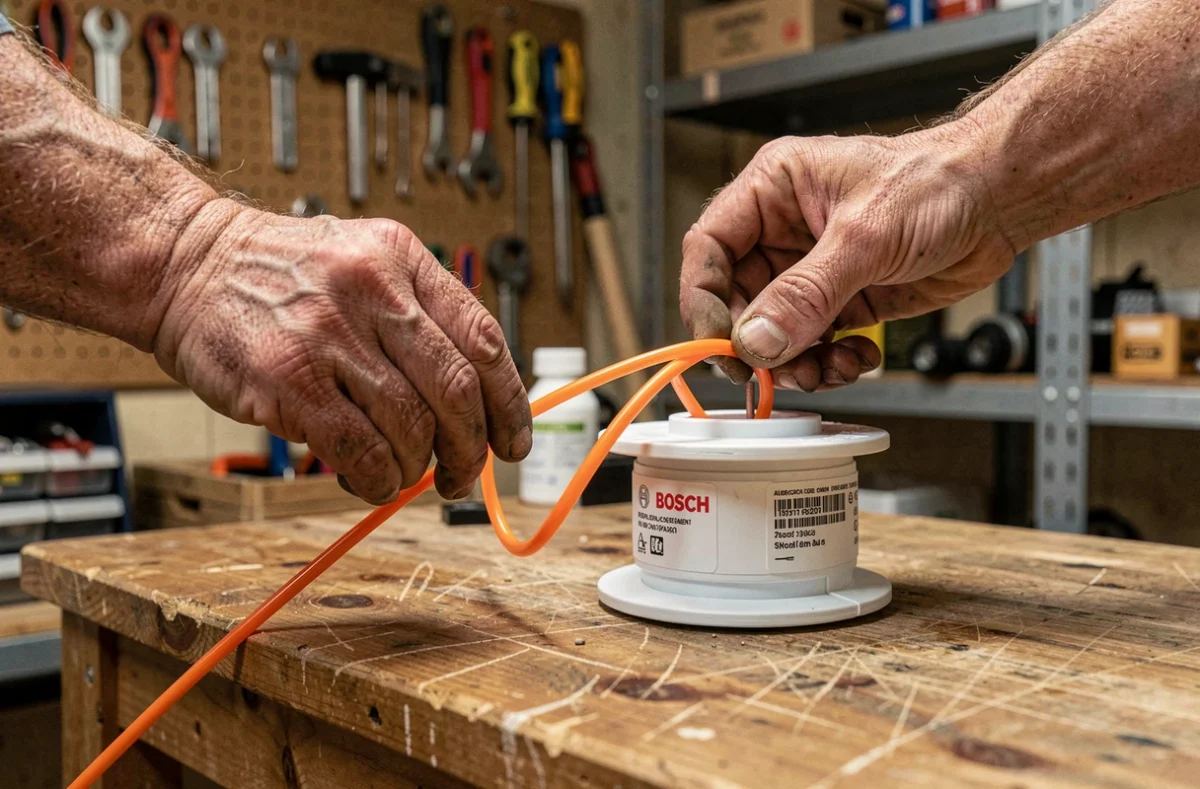
Changing the line is a good time to check the entire head, not just the spool. Removing grass wrapped around the disk and checking the tightness of the nut prevents breakdowns during use. Wet grass accumulates around the shaft and creates a compact mat that hinders rotation.
Before closing the casing, we recommend inspecting three areas:
- The accessory support disk, which should show no cracks or deformation
- The cutting blade integrated into the casing, which should be sharp and not chipped (it is what cuts the line to the correct length)
- The locking clips of the spool cover, which should snap into place without forcing
An abnormally light part or one showing micro-cracks should be replaced. A cracked casing allows line or debris projections to escape and compromises user protection. Protective equipment (glasses, long pants, closed shoes) remains essential during any maintenance operation, even brief.
Automatic feed spool or manual head: adapt the method
On Bosch models with automatic feed, the line is gradually released by centrifugal effect during rotation. Simply replace the entire spool or rewind the line according to the procedure described above. The cover usually unclips by pressing on the side tabs, without tools.
Manual reloading models work differently. The line is cut into straight segments, inserted into slots in the head. No winding, hence no risk of coil crossing. However, the length of each segment must match the dimensions of the slot exactly, or else there will be imbalance and unwanted vibrations.
Identifying the system of your machine before purchasing line or a replacement spool remains the most cost-effective precaution. The user manual (available online for almost all Bosch models) specifies the type of head, compatible line diameter, and maximum length per spool.
A well-executed replacement, with the right line and careful winding, preserves both cutting power and motor lifespan. Taking five minutes to inspect the complete head at each spool recharge is enough to avoid most common breakdowns on Bosch trimmers.