
A child who refuses to get dressed at 7:45 AM, an improvised dinner with leftovers from the fridge, a couple that only communicates in logistical terms: family life unfolds in these micro-moments, not in grand resolutions. Building a thriving family routine requires less theory and more concrete, repeated adjustments tailored to each household.
Parental technoférence: when the phone disrupts the relationship with the child
We know the debates about children’s screen time. There is much less discussion about the impact of parents’ phones on the quality of family interactions. Santé publique France has documented this phenomenon under the term parental technoférence: an adult checking their phone during an interaction with their young child disrupts the bond, even briefly.
The problem is not limited to toddlers. A parent scrolling at the table or during homework sends a clear signal: what happens on the screen takes precedence. Feedback on this point varies among families, but the mechanism remains the same. The child picks up on the emotional unavailability and adapts, either by escalating to attract attention or by withdrawing.
On the solutions side, we often find generic recommendations (“put down your phone”). What works better is to define screen-free zones for adults as well, not just for children. The kitchen during mealtime, the bedroom at bedtime. The rule applies to everyone, including parents, which avoids the double standard that children immediately recognize.
Santé publique France also emphasizes that digital practices vary according to parents’ education levels. A uniform recommendation on screens does not cover the reality of all households. It is beneficial to identify one’s own triggers (work notifications, social media, group messaging) rather than applying a standard recipe. On the family section of Gazette Debout, these questions of family balance are addressed from several complementary angles.
Mental load and couple life: sharing without keeping score
The mental load remains a major source of tension in families. The Ifop barometer for News RSE on family load (wave 2, 2025) confirms that family balance requires an explicit distribution of invisible tasks. Remembering medical appointments, anticipating seasonal clothing, managing school registrations: these micro-tasks accumulate and often weigh heavily on one parent.
You don’t resolve the mental load with a shared Excel spreadsheet. The real lever is the complete delegation of a domain, not occasional subcontracting. If one parent manages meals, they handle the shopping list, the weekly menu, and checking the fridge. The other does not “help”: they take on an entire block, from A to Z.
Concrete points to clarify between parents
- Who manages each child’s medical appointments (making appointments, tracking the health record, vaccine reminders) and not “who accompanies when they can”
- Who oversees school logistics (supplies, outings, correspondence with teachers) without the other needing to follow up
- Who anticipates vacation periods and childcare arrangements, including backup solutions when the initial plan falls through
This clarification is not romantic. It avoids implicit reproaches and frees up time for exchanges that do not revolve around domestic organization. The couple finds space when logistics no longer monopolizes every conversation.
Parental presence leave: an unknown family right
When a child is affected by a serious illness or disability, family life shifts dramatically. Articles on family flourishing rarely mention the legal provisions that exist for these situations. The parental presence leave allows up to 310 working days per child, spread over a maximum period of three years, with a daily allowance under certain conditions.
This provision remains underutilized because it is poorly known. Many affected parents discover its existence late, sometimes after exhausting their regular leave or reducing their working hours without compensation. Checking eligibility with the CAF or their employer as soon as a diagnosis is announced allows for a more stable framework for the entire family.

Daily family rituals: anchoring stability without rigidity
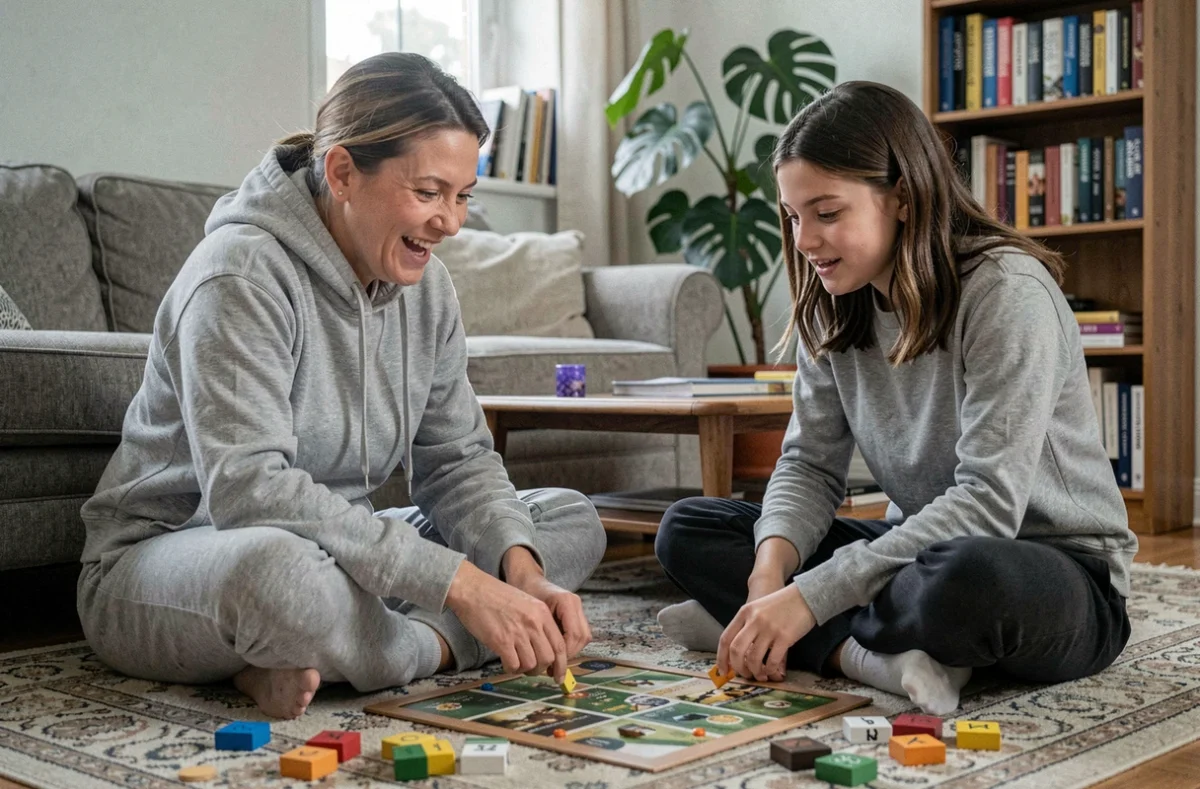
Family rituals are not exceptional activities. A breakfast together on Sunday, a walk after school, ten minutes of shared reading in the evening: regularity matters more than duration or originality.
A common mistake is to multiply rituals to the point of turning daily life into a program. Three simple and manageable rituals are better than seven commitments that are abandoned after two weeks. You choose based on what already works spontaneously in the family, then make it explicit.
With older children, these rituals evolve. A teenager no longer wants a story read to them, but they might accept a weekly meal without phones or a recurring outing with a parent. Adapting the ritual to the age prevents it from becoming a constraint rather than a reference point.
A thriving family life does not rely on a single model. It depends on precise adjustments: managing one’s own screens before regulating those of the children, distributing the mental load in complete blocks, knowing one’s rights when situations become complicated, and maintaining a few stable reference points without making them a rigid program. It is these repeated gestures, adapted to each family configuration, that build a sustainable daily life over time.