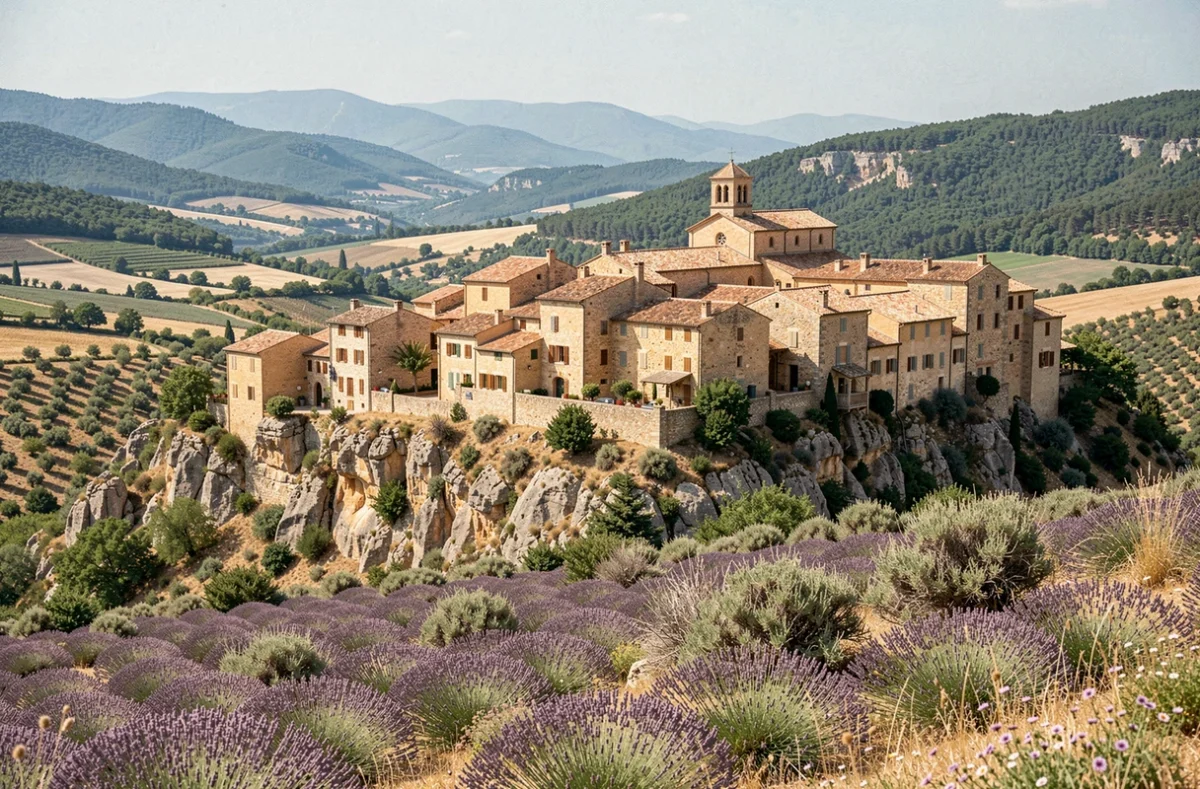
When you arrive in Apt on a Saturday morning, the Provençal market spills onto the banks of the Calavon. Candied fruit, goat’s cheese, loose lavender: everything comes from within thirty kilometres. This market captures the essence of the Pays d’Apt, an area of 25 communes and more than 29,000 residents, where heritage, agriculture and conservation initiatives are evident at every turn.
Geology and ochre: what the Pays d’Apt’s subsoil reveals
Most Luberon travel guides mention the Ochre Trail in Roussillon or the Provençal Colorado in Rustrel. The Luberon Regional Nature Park also offers geological interpretation, with its geology museum located at the Maison du Parc in Apt.
Here, visitors can discover the geodiversity of the Luberon UNESCO Global Geopark, through activities exploring sedimentary formations, fossils and the processes that created these natural pigments, which have been mined for centuries.
This perspective has a practical impact. Understanding why the cliffs at Rustrel are red while those at Buoux are grey changes the way you see the landscape. The Société des Ocres de France, based in the area, continues to process this pigment for industrial and artistic uses. Practical information about the communes, services and local life is available on cc-paysapt.fr, the community of communes’ website.
Pastoralism in the Luberon: managing the landscape through livestock farming
The dry hills north of Apt, between Viens and Lagarde d’Apt, remain open thanks to grazing flocks. The Luberon Regional Nature Park documents how extensive livestock farming maintains open habitats and biodiversity while reducing the risk of wildfires. Without this pastoral activity, scrubland would take over within a few years, natural firebreaks would disappear and wildlife associated with dry grasslands would decline.
This connection between the agricultural economy and land management is rarely highlighted in tourism content. Yet flocks can be spotted along hiking trails, among holm oaks and dry-stone walls. Pastoralism in the Luberon is not a folkloric relic; it is an active tool for environmental management.
What this means for visitors
Some transhumance routes are open to walkers. Meeting a shepherd and their flock on the Claparèdes plateau offers a different perspective on the landscape from visiting a hilltop village. Local producers, including goat’s cheese makers and lamb farmers, sell directly to customers at the markets in Apt and Saint-Saturnin-lès-Apt.
Cycling and touring in the Pays d’Apt: a well-developed offer since 2020
Since 2020, the Park has been developing the Espace VTT Provence Luberon Lure with public and tourism partners. The aim is not simply to offer a handful of signposted routes, but to develop a certified cycling destination covering mountain biking, e-mountain biking, gravel cycling and multi-day touring routes.
This range of activities makes a real difference. A gravel cyclist riding from Apt to Saignon along farm tracks has a very different experience from a mountain biker tackling the technical singletrack in the Ochre Massif. Both can find well-maintained, signposted routes.
- Mountain biking and e-mountain biking: technical routes through limestone hills and oak forests, with elevation gains suited to different ability levels
- Gravel cycling: farm tracks and forest paths between villages, ideal for combining heritage with physical activity
- Touring: multi-day routes linking the Pays d’Apt with the rest of the Luberon and the Pays de Lure, with accommodation along the way
This cycling offer positions the Pays d’Apt as a place where cycling becomes a way to explore in its own right, not just a Sunday pastime.
Sustainable tourism in the Pays d’Apt: practical action, not empty labels
The Valeurs Parc label recognises local businesses committed to responsible tourism. On the ground, this commitment translates into measurable actions. The Moulin des Ocres in Roussillon is trialling ways to reduce its environmental impact. The Hôtel Sainte-Anne in Apt has fitted its rooms with water-saving showerheads. These initiatives may be modest individually, but they add up across an area of 25 communes.
Local supply chains and mobile presses
Jus Pur Lub is a mobile press that travels to producers across the Luberon. Fruit—apples, pears and grapes—is processed on site, without transport or intermediaries. This kind of initiative demonstrates a local circular economy that shortens the distance between production and processing.
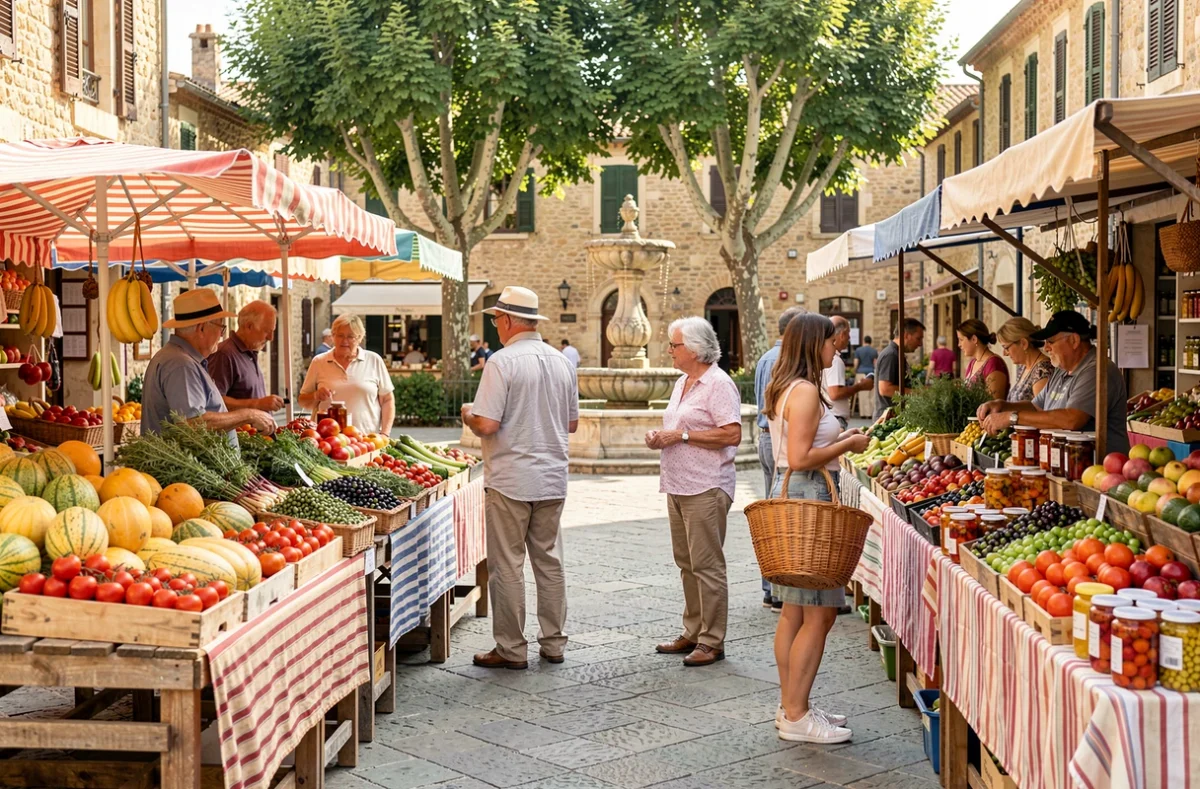
Weekly markets in Apt and the surrounding villages remain the main sales channel for these producers. You can find everything from artisan jams to olive oil pressed within just a few kilometres.
Built heritage in the Pays d’Apt: beyond the hilltop villages
The Pont Julien, a Roman bridge dating from the 1st century BCE on the former Via Domitia, is one of the best-preserved ancient bridges in France. Apt itself, founded under the name Apta Julia, still bears traces of this period in its urban fabric.
But the heritage of the Pays d’Apt is not limited to listed monuments. Bories (dry-stone huts), restanques (agricultural terraces), the ramparts of Saignon and the calades of Bonnieux tell a story shaped by the everyday use of the land. This fragile, scattered vernacular heritage depends directly on upkeep by residents and local authorities.
The Pays d’Apt’s distinctive character comes from the way these elements overlap: geological layers visible to the naked eye, agriculture that shapes the landscape, soft mobility options taking shape and built heritage whose value lies as much in its use as in its age. Every cliff face, agricultural terrace and signposted trail points to a specific geological, economic or historical fact.